


SEO in 2026 isn’t just about rankings and clicks anymore. It’s about whether your content shows up at all across AI-driven search experiences. Generative Engine Optimisation (GEO) builds on traditional SEO by helping your content get found, understood and reused by AI tools, without throwing out the fundamentals that already work.
If you’ve been paying attention to search over the past year, it probably feels like the ground is shifting under your feet.
Google results now come with an AI summary attached. People are asking ChatGPT things they used to Google without a second thought. Zero-click searches are no longer the exception. And suddenly there’s a new acronym in every SEO conversation: Hello, GEO.
Luckily, you don’t need to set everything you know about SEO on fire and start again.
Generative Engine Optimisation isn’t a replacement for Search Engine Optimisation. It’s what happens when good SEO is applied to a world where search no longer lives in one place. GEO is about making your content easier for AI-driven tools to find, understand, trust and use, whether that answer appears in a Google AI Overview, a conversational search tool or somewhere else entirely.
If you already have a strong brand, genuinely helpful content and a solid technical foundation, you’re not behind. What’s changed is how content needs to be structured and distributed so AI tools can confidently use it, not just rank it.
This article breaks down what SEO actually looks like in 2026, why GEO exists and how to adapt without losing your mind or starting from scratch.
Jump to:
- SEO isn’t dying. It’s multiplying.
- What’s the go with GEO?
- Why search looks different now
- Why traffic isn’t the only metric that matters anymore
- How to approach GEO in practice (without overthinking it)
- The bottom line
SEO isn’t dying. It’s multiplying.
Think about the last time you needed an answer quickly. Not a deep research project; just a “help me understand this” moment. (Mine was yesterday, when my brother asked ChatGPT for the definition of charcuterie after our charcuterie board arrived sans cheese).
Maybe you Googled it.
Maybe you asked ChatGPT.
Maybe you searched TikTok, scrolled Reddit or skimmed a forum thread.
You probably didn’t think of any of that as “search”. You were just trying to get an answer.
That’s the shift.
Google is still enormous. It still plays a critical role in how people discover brands, products and information. But it’s no longer the only place people go to get answers. AI tools, social platforms and community forums now sit alongside it as part of the same messy, overlapping search journey.
People move between these places depending on:
- How complex the question is
- How much effort they want to expend
- How confident they feel in the answer
And that’s why SEO hasn’t disappeared. It’s multiplied.
What we used to think of as “doing SEO” – ranking a page, earning a click, measuring a session – is now only one possible outcome in a much broader visibility problem.
What’s the go with GEO?
GEO stands for Generative Engine Optimisation, which sounds intimidating, but the idea itself is pretty straightforward.
It’s about optimising your content so AI-powered search experiences can find it, understand it and confidently quote it in their answers.
That includes Google’s AI Overviews, but also conversational tools – like ChatGPT, Claude and Perplexity – where people ask follow-up questions, compare options and refine decisions without ever seeing a traditional results page.
Part of why SEO feels confusing right now is that a few different ideas keep getting lumped together. They’re related, and they influence each other, but they’re not the same thing.
Here’s the simplest way to separate them:
- SEO (Search Engine Optimisation) is about getting pages to rank and earn clicks. It’s the foundation we’ve all been working from for years.
- AEO (Answer Engine Optimisation) is about helping content appear as direct answers in featured snippets, People Also Ask boxes and even voice search responses. It’s short, specific and to the point.
- GEO (Generative Engine Optimisation) is about being cited, summarised and referenced inside AI-driven search experiences. It’s less about a single answer and more about whether your content becomes part of the explanation.
The mindset shift is subtle but important.
Where traditional SEO has trained us to ask, “How do I get to position one?”, GEO requires us to ask a different set of questions, like:
- How do I get cited in an AI Overview?
- How do I become the brand these tools mention by name?
- How do I stay visible when nobody clicks anything?
Here’s the very important bit: GEO only works if your SEO fundamentals already do.
If your site is slow, thin on content, confusing or impossible to crawl, no amount of AI optimisation wizardry is going to save it. The same SEO foundations you already know still apply, just through a wider lens.
Why search looks different now
Search is no longer one platform, one query or one click. It’s fragmented, conversational and increasingly zero-click.
AI tools, social platforms and community forums are now part of the same search journey. People move between them to get answers faster, with less friction, and often without ever intending to visit a website. GEO is about showing up across that whole messy middle.
Here’s what we’re seeing right now:
AI blocks are eating the fold
On both desktop and mobile, AI summaries and answer boxes are taking up more screen space. Traditional organic listings still exist, but they’re often pushed way down the page.
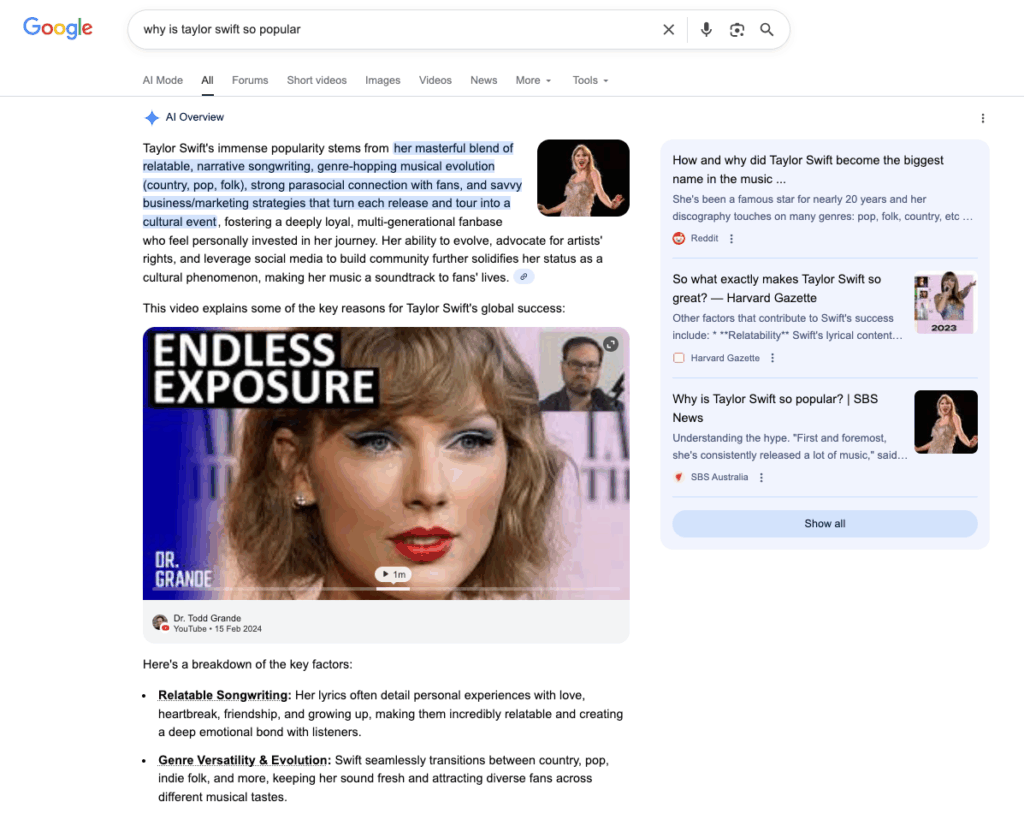
The old SEO can’t come to the phone right now. Why? ‘Cause she’s dead been busy multiplying!
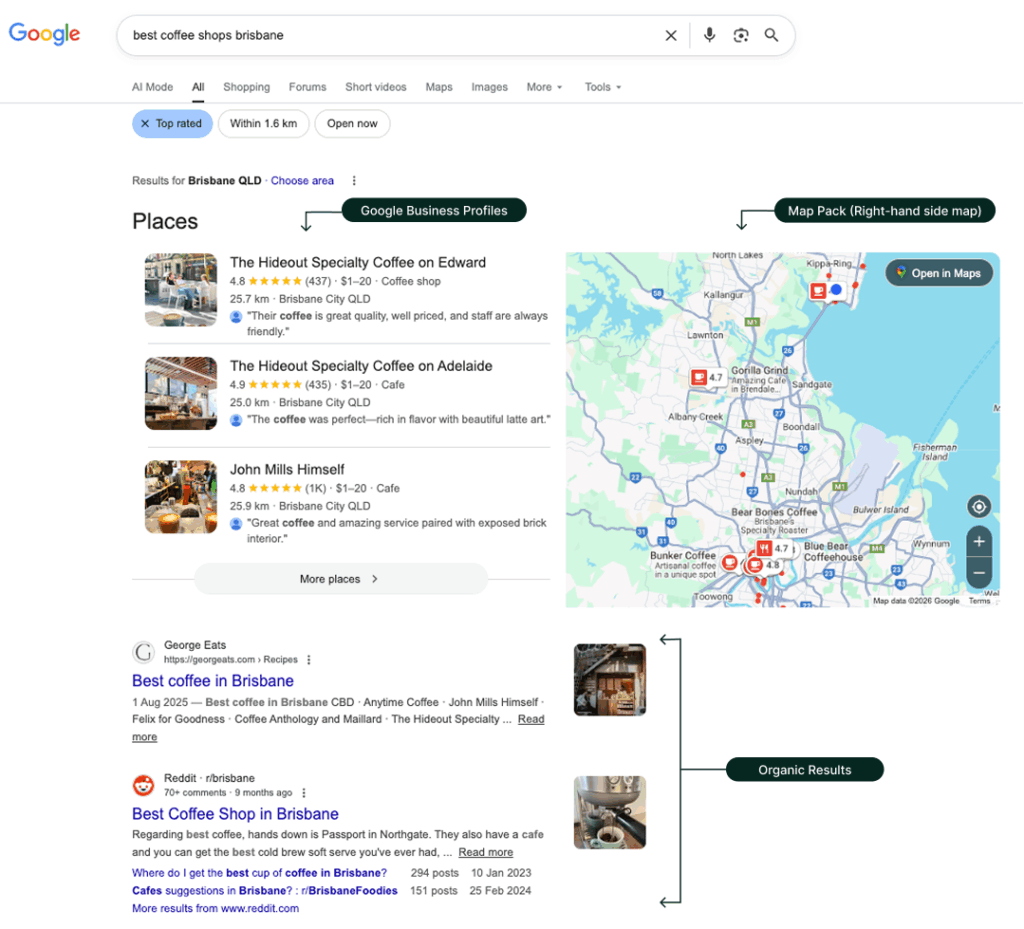
Zero-click searches are the default
People are getting what they need directly from:
- Featured snippets
- AI overviews
- Google Business Profiles
- Knowledge Panels
- Map Packs
This is simply how search is designed to work now.
Search is becoming conversational
On AI tools, people don’t ask one neat question. They ask follow-ups, compare options and refine their thinking. A search session now feels more like a chat thread than a keyword query.
Discovery is happening everywhere
TikTok, Instagram, YouTube and Reddit all function as search engines in their own right. Google is indexing that content from many of these platforms and pulling them into results.
GEO accepts this reality. Instead of fighting zero-click behaviour, it works with it by aiming to be the brand that gets quoted, cited and remembered.
Why traffic isn’t the only metric that matters anymore
Visibility doesn’t always mean being visited.
A growing number of searches now end without a website visit at all.
People get answers from AI Overviews, featured snippets, local panels and summaries that surface directly in the interface. They might read, compare and make a decision without ever clicking through, especially for informational or research-heavy queries.
That doesn’t mean search has stopped working. It means the outcome has changed.
AI tools process billions of prompts every day. Almost none of that activity shows up as referral traffic.
Your brand might be mentioned repeatedly in AI-generated answers. Your product might be recommended in conversational searches. Your company might appear consistently inside AI Overviews.
None of that appears in Google Analytics.
Traffic still matters (especially for transactions), but it’s no longer the only signal that search is doing its job.
Instead of asking, “How many clicks did this get?”, teams are starting to look at brand mentions, search demand and whether their content shows up in the moments people are actually asking questions.
If traffic is the only thing you measure, you’re missing a big part of the picture.
How to approach GEO in practice (without overthinking it)
One of the more persistent myths online around GEO is that your content needs to sound more “AI-friendly”.
It doesn’t.
Your writing should still sound human (we’ve been saying this for years). What has changed is how clearly that content is structured, and how easy it is to understand at a glance.
While no one yet has a complete view of how AI engines decide which sources to cite, some patterns are already emerging.
Content that tends to get surfaced is:
- Clearly structured
- Easy to quote
- Backed by data or concrete detail
- Written with confidence and expertise
The slightly ironic part is that these are just solid SEO fundamentals.
Highly cited pages don’t always have the most traffic, the most backlinks or the highest rankings. Often, they’re simply the easiest to understand.
AI engines don’t reward what’s loud. They reward what’s clear.
Here are a few fundamentals to focus on:
Write for humans, structure for AI
On key pages and blogs, focus on making your content easy to scan, lift and reuse, without stripping it of personality.
That means things like:
- Include a short “in a nutshell” answer near the top
- Use headings that mirror real questions people ask
- Start sections with a brief summary before expanding
- Include one clean, quotable sentence for each section
- Use bullet points, numbered lists and tables where they genuinely help
- For longer pieces, include:
- A table of contents
- A short summary or key takeaways box near the top
This makes content easier to skim, and it makes it easier for AI tools to identify the part that actually answers the question.
Optimise for intent, not volume
Broad keywords matter less than they used to. What matters more is usefulness.
Instead of chasing traffic potential, ask:
- What would a qualified lead search?
- What follow-up questions would they ask?
- What context would they need to make a decision?
Make expertise obvious
If AI systems are deciding whether to trust and reuse your content, it helps to be very clear about who’s behind it.
- Add or improve author bios
- Reference real experience and examples
- Use expert quotes where appropriate
This strengthens E-E-A-T signals (Experience, Expertise, Authoritativeness, Trustworthiness) and human credibility.
Treat content beyond your blog as search assets
Your website isn’t the only place your content lives anymore.
Optimised YouTube videos, Instagram reels, Linked-In posts and other third-party content all contribute to how your brand shows up in AI-driven search. Distribution matters more than it used to.
Don’t skip the basics
None of this replaces technical SEO.
Fast pages, accessibility, clean site structure and basic schema are still non-negotiable. GEO builds on solid foundations; it doesn’t bypass them.
The bottom line
GEO isn’t about throwing out everything you know and starting from scratch.
It’s about recognising that the front door to your content has changed. Sometimes that door is a classic Google result. Sometimes it will be an AI Overview, a Reddit thread, a TikTok or a ChatGPT answer.
If you keep creating genuinely helpful content, structure it clearly and build a brand people trust, GEO stops feeling like a scary new rulebook and starts feeling manageable.
Zoom out far enough and you’ll see it clearly: GEO is just good SEO, applied everywhere search now happens.